Drive solutions for injection molding machines
Baumüller offers a comprehensive portfolio for servo-hydraulic, hybrid, and fully electric injection molding machines. With optional regenerative systems, intelligent software and simulation solutions, as well as efficient synchronous motor technology. The drive technology products make an important contribution to the energy-efficient and precise production of even highly complex injection molding parts.
Topology
Clamping drive
Fast build-up of the closing force and dynamic movement of the toggle kinematics are decisive for the clamping drive. Find out more
Ejector drive
The requirements of high-speed injection molding machines and the characteristics of dynamic synchronous motors were taken into consideration and perfected for the ejector drive.
Visualization
The powerful b maXX HMIs offer a comprehensive, integrated software package and other features. Find out more
Plasticizing drive
In the energy-intensive plastification process, efficient drive technology can reduce the energy consumption significantly. Find out more
Injection drive
The injection process is of decisive importance, in order to produce exact and precise injection molded parts. Find out more
Servo drives
Baumüller offers all kinds of different system solutions for the injection molding industry. Find out more
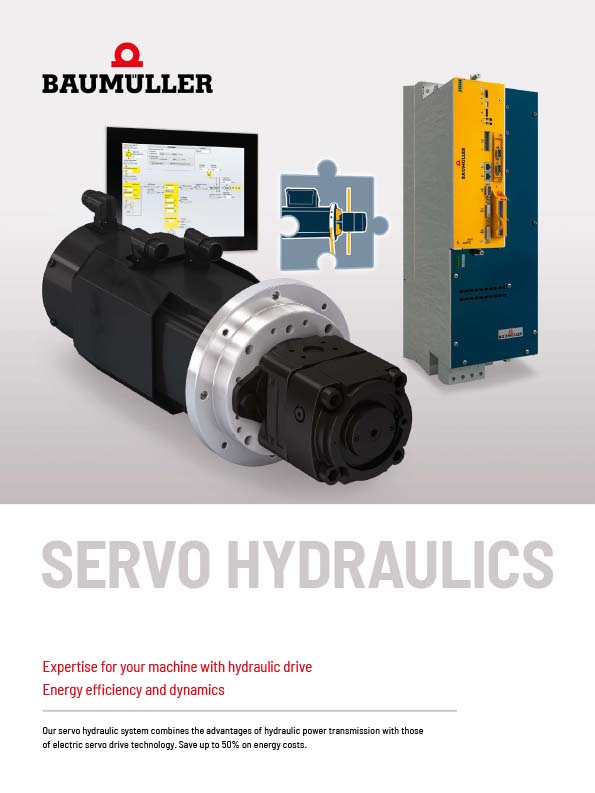
Servo-hydraulics
The servo pump solution reduces the energy requirement in hydraulic and hybrid machines. Find out more
Application example: Fully electric injection molding machine:
“The fully electric injection molding machine offers a clever combination of energy savings and increased precision. The highly dynamic pressure and flow rate control with a cycle time of 125 µs ensures maximum precision and repeatability, which we require for the optimal operation of our compact injection molding machines. The design can be flexible. The motors can be optimally adapted to the conditions in our injection molding machines, both mechanically and electrically.”
Dipl.-Ing. Martin Kaiser, Technical Director Dr. Boy GmbH & Co. KG

Benefits of the electric drives and intelligent controller functions
Solutions for hybrid and fully electric machines
Baumüller offers a wide range of system solutions for the injection molding industry. The best choice of system depends primarily on the product manufactured by the machine and thus on the machine configuration. The number of axes to be electrified also plays an important role.
Clever buffering
Thanks to its scalability, the compact drive system with multiple drives can be optimally adapted to the power requirements of the injection molding machine. Moreover, it is no longer necessary to draw the short-term peak power required for individual drives from the mains. Instead, the energy can be distributed within the DC link system.
Your benefits
- Better energy efficiency
- Smaller feed units
- Minimized thermal power loss
- No need for / downsizing of brake resistors
- Space-saving and cost-lowering
Drive topology with feed unit for fully electric machines

Optionally, a capacity module can be integrated into the DC link for buffering excess energy. This means that energy can be stored and freed up again as needed in the event of a power failure or when braking the drive axes. Furthermore, after a power supply failure or error, it is possible to move the drive axes to a defined position depending on the available residual energy. This prevents damage and accelerates a machine restart.
Drive topology with regenerative feedback unit for fully electric machines

In addition to supplying power to the power modules, the use of a regenerative feed unit also enables the sinusoidal feedback of excess braking energy into the power supply system. This regenerative system thereby makes an additional contribution to reducing energy consumption.

For servo-hydraulic machines with one electric axis, a powerful mono unit is used in combination with a compact and dynamic servo motor.
The module system combined with a mono unit in a DC link system is useful, for example, for the electrification of a few axes in combination with a high-performance drive axis. The starting point is often an already implemented servo-hydraulic drive, which is supplemented by additional electric axes. In this case, the large, powerful mono unit is linked directly to the module system via intelligent connection technology. This saves space in the control cabinet and is easy to implement, as both unit types use the same firmware. The degree of electrification of servo-hydraulic machines can thus be increased in an economic way thanks to the limited engineering work required and the elimination of a separate power feed.
All drive solutions are compact and scalable, and allow high power density. Due to the identical controller firmware, costs for project planning, maintenance, and service are also reduced.
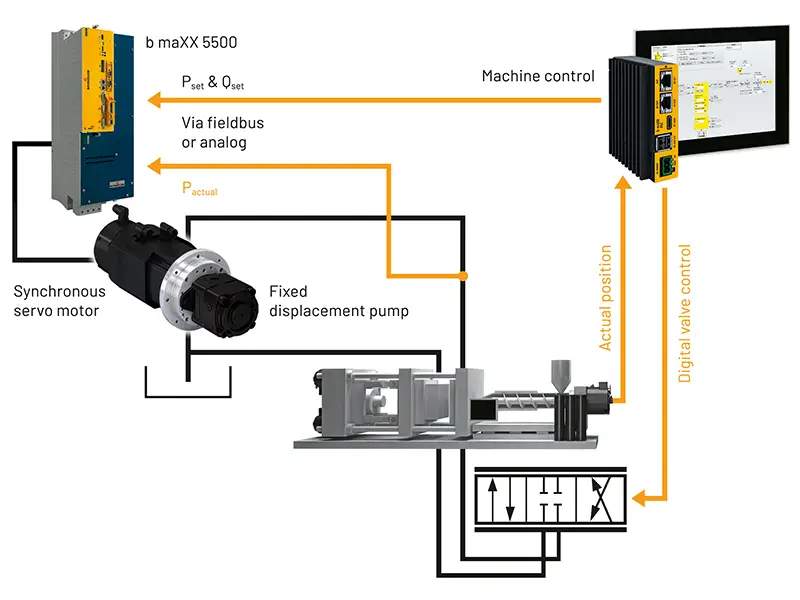 Example of the structure of a servo-hydraulic system in an injection molding machine
The servo-hydraulic drive system
The servo-hydraulic system consists of a servo drive that controls a synchronous servo motor. This motor drives a constant pump. The pressure and volume flow set values (Pset and Qset) are sent from the control unit to the servo drive. Pressure and flow rate are controlled on the servo drive by adjusting the speed. As in the conventional hydraulic systems with standard motors, the actual positions are read out via the machine control unit. The machine builder provides the system supplier with the flow rate and pressure values required for the design of the drive system. Baumüller undertakes the design of the entire drive system, including the pump, motor, and the servo drive.
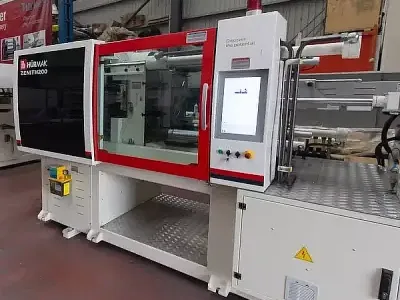
Servo pump solution for higher efficiency
Hürmak, the Turkish market leader in plastic injection molding machines, has been able to achieve higher energy efficiency, reproducibility, and product stability in its machines thanks to the servo pump solution from its automation partner Baumüller.
- Servo pump solution optimizes hydraulic machine
- Servo pump solution for higher efficiency

Precise plastic parts in record time
Baumüller supplies a highly dynamic and compact drive system for BOY Electric injection molding machines from Dr. Boy GmbH & Co. KG.
- Minimal installation space for precise injection molded parts
- Patented back pressure measurement without additional components
- Servo motors for increased dynamics

Electrified plasticizing unit – Next Level for energy savings and carbon dioxide reduction
Baumüller supplies energy-efficient direct drives for the ZENITH 580 injection molding machine from Hürmak Machinery and thus drives electrification forward
- Sustainability and carbon dioxide emissions
- Electrified plasticizing unit
- Parallel functions and cycle time reduction
References:






Integrated protection functions for the plastics industry
Error response to encoder failure
Application example: Closing process of an injection molding machine
The problem: If the sensor fails during the injection mold closing process, this can cause significant damage to the closing tool of the injection molding machine, as it would slam shut with enormous force without slowing down and break. This leads to a longer-term loss of production, as a new mold must first be manufactured, and also incurs high repair costs.
The solution: The "error response to encoder failure" function was developed to solve precisely this problem. The controller firmware in the b maXX inverters checks the status of the encoder every microsecond and automatically switches to open-loop control in the event of an encoder error. Depending on the parameterization of the controller, the system is then immediately braked and brought to a standstill. At the same time, information can be sent to the control system via the fieldbus so that the entire machine can be controlled and shut down synchronously. This way, the clamping process is terminated without damage and machine comes to a stop.
The benefit: No damage to the mechanics or tools due to uncontrolled coasting
Gantry function with synchronous error response
Application example: Movement of the clamp on an injection molding machine
The problem: The movement of the clamp on an injection molding machine can be controlled via two gantry axes, for example. If one axis fails and the other continues to move, the clamp will jam. Mechanical damage can occur. This results in high repair costs and production downtime.
The solution: The "gantry function with synchronous error response" prevents the clamp from tilting by ensuring that, in the event of errors, both axes always respond synchronously, i.e., at the same time and with the same movement. This happens automatically after an error is detected and with no time delay. Once the error has been corrected, the axes can continue to move in gantry mode. This fully excludes the possibility of mechanical damage.
The benefit: Protection against damage to the mechanics thanks to consistent response behavior
PWM frequency switchover
Application example: Injection molding machine holding pressure phase
The problem: For example, in the holding pressure phase, the speed is extremely low. IGBTs are subjected to high loads. If appropriate measures are not taken, the losses are enormous and the life of the power semiconductor is also short.
The solution: Due to the “PWM frequency switchover” control function, the cycle losses are reduced and currents can be run for a longer time. It is used during the pressure or torque holding process at low speeds and extends the service life of the IGBT units. Further advantages are reduced IGBT losses and an extended torque or pressure holding duration. By shifting the standard pulse width modulation down from 4 to 2 kHz the torque can be held longer without damaging the end stage.
The benefits: service life-friendly, higher currents can be run at low speeds, e.g., in order to maintain the pressure during the holding pressure phase.
Write us a message, our sales experts will be happy to advise you.