


Modularization
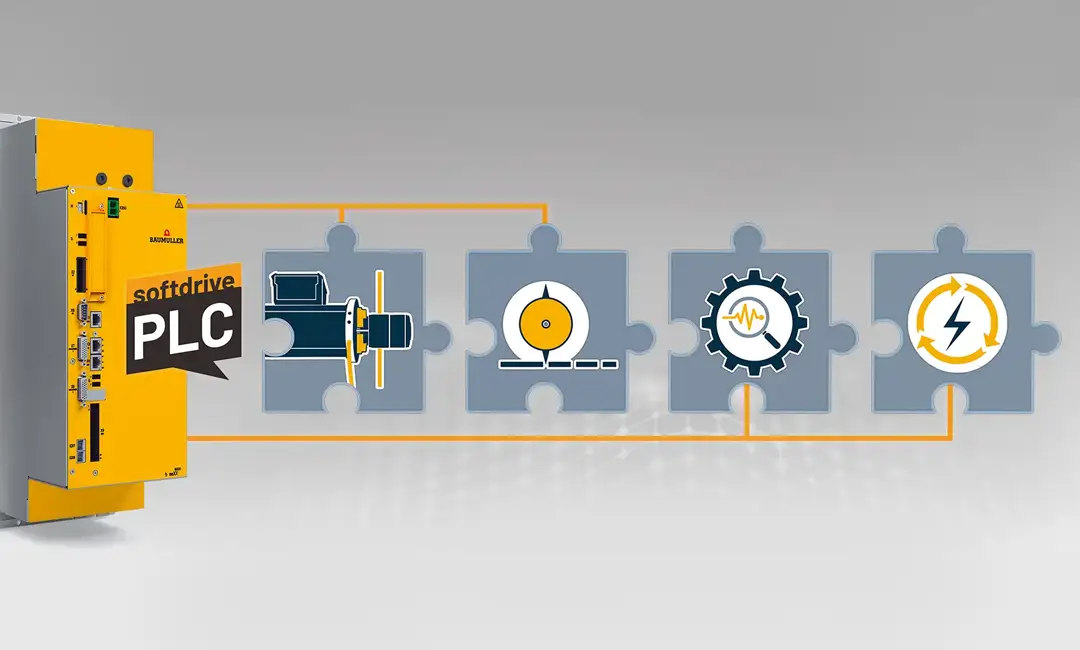
Modularization is only possible with intelligent drive technology. Machines are increasingly designed as modular systems so that, for example, individual modules can be completed and tested at different locations. When machine modules are self-contained, they can be commissioned separately, eliminating the need to commission the completed system as a whole. The superordinated control then communicates only with the intelligent servo drives in the machine modules rather than with the individual system components. Baumüller offers the necessary hardware and software for modular machines and even provides preprogrammed, encapsulated module libraries for many functions. This allows individual functions to be put into operation quickly and without errors or programming expertise.
High availability and energy efficiency

Decentralized intelligence is useful for monitoring the availability of the drive system. For example, firmware-based vibration analyses can be used to monitor the system without external sensors and detect problems at an early stage. If the system is also connected to the cloud or an edge PC, it can become IoT-enabled via OPC UA, for example. The machine manufacturer can then offer its customers enhanced services, thereby opening up new business models.
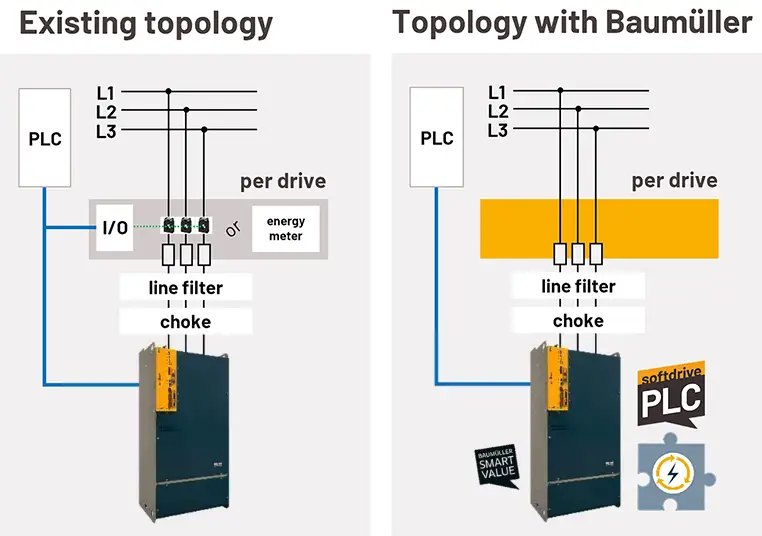
Another way to use the data from the drive is to improve energy efficiency. Intelligent converters can measure energy consumption and monitor the maximum load on the electric drives during power peaks without additional hardware. This information can be used to identify potential savings and determine optimal drive sizing, or to set warning thresholds for unintended changes in the production process. This optimizes energy consumption, reduces the associated carbon footprint, stabilizes and optimizes processes, and is also an economically viable solution.
High speed and product quality
When it comes to productivity and safety, shifting intelligence to the drive offers another major advantage: speed. If the volume of data transmitted via the fieldbus becomes too large, setpoints, for example, can no longer be transmitted at the required speed. Particularly in highly dynamic processes – such as those in the printing or packaging industries – this comes at the expense of precision, dynamic performance, and ultimately machine productivity. If intelligence is distributed across the system, only preprocessed data – or even just status messages – are transmitted between the drive and the central control unit via the fieldbus. The setpoint and actual values for motion control and safety tasks are processed directly within the machine module at much higher cycle rates.
If safety functions are integrated directly into the drive, the corresponding fieldbus dead times are eliminated when STO is triggered, for example. This can boost machine speed and shorten process cycle time without increasing the level of risk at the machine. Even when the focus is not on safety but on synchronizing a large number of dynamic drives, it is beneficial to bypass these fieldbus dead times and specify the setpoints directly via the drives. The fast response times also offer advantages, for example, when processing materials with varying properties. High-performance communication enables the use of adaptive control to compensate for these variations in material properties. This ensures consistently high quality of the final product even at high production speeds.
Simplification of PLC projects
Using decentralized intelligence makes PLC projects less complex. With a central control unit, all calculations are performed centrally. The tasks involved range from machine startup and the calculation of all setpoint and actual values for each motor to additional tasks such as data acquisition and processing for IoT applications. If the machine features a modular design, all tasks relating to a particular machine module can be handled by the intelligent drive. This significantly reduces the complexity of the PLC project in the central control unit. At the same time, this allows different machine modules to be combined as required.
Use of AI
In the coming years, artificial intelligence will become an indispensable part of manufacturing facilities around the world. Making the right data available is essential for successful use. Because of their proximity to the process, intelligent servo drives can provide this data faster than the central control unit and act as a data hub, thereby enabling optimal performance for AI applications. In addition, the drives can serve as sensor hubs when combined with external sensors.

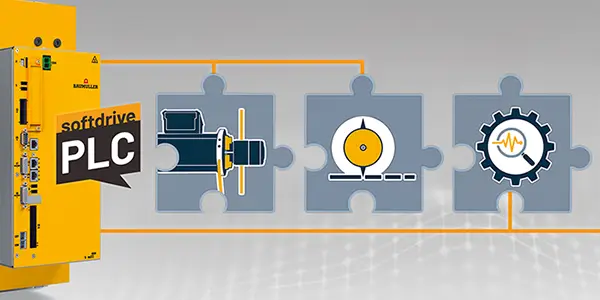
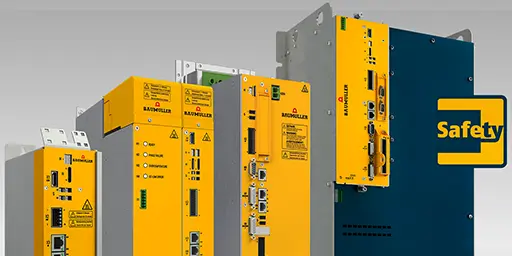
To relocate functions from the central control unit to the controller, Baumüller offers two drive-integrated control solutions: the b maXX softdrivePLC with a cycle time of ≥ 62.5 μs and the b maXX drivePLC with a fieldbus cycle time of ≥ 250 μs. The software-based b maXX softdrivePLC for single-axis applications combines motion control and PLC functionality and can be programmed in accordance with IEC 61131. The b maXX drivePLC enables more complex motion control, technology, and control functions to be performed directly in the drive. Since the drivePLC can also be used as an EtherCAT master to control additional servo converters, the processing load on the central PLC can be reduced, allowing the PLC to be downsized or even eliminated entirely.
Technology functions directly in the drive
Servo drives

The fields marked with an asterisk (*) are mandatory.


