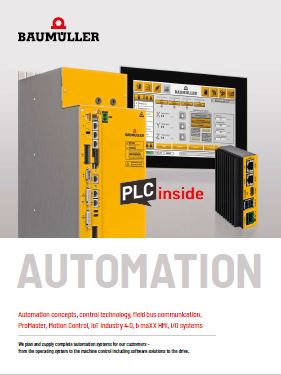
Drive-Integrated Intelligence
Intelligent servo converters provide functions that extend beyond closed-loop control. They handle motion control, monitoring, and communication, thereby enabling decentralized drive concepts. Relocating functions from the central control unit to the converter speeds up processes, enables modular machine architectures, and makes it possible to use IoT and AI. Baumüller’s intelligent converters offer a high degree of flexibility because they are compatible with superordinated controls from other manufacturers.

Drive Intelligence
Baumüller coined the term Drive Intelligence to describe the concept of intelligent servo converters.
In addition to handling closed-loop control tasks, the intelligent b maXX servo converters perform control functions, autonomously optimize their operation, and are IoT-enabled.
Baumüller is a pioneer in drive-integrated intelligence.
Our core competency is controlling complex, highly dynamic motion with exceptional precision. Our goal is to enable every machine manufacturer to use this high-performance motion control in their machines. That is why we introduced intelligent converters more than 30 years ago, allowing these solutions to be integrated independently and flexibly into any existing machine topology. As a result, our customers achieve higher machine performance, reach the market faster, and can respond flexibly to customer requirements.
Drive Intelligence advantages

Performance: If the intelligence is distributed decentrally, only preprocessed data or even only status messages are still transmitted via the fieldbus communication between the drive and central control unit. The actual target and actual values of the motion control and safety tasks are processed directly within the machine module at the much faster controller cycle.
This shortens cycle times and increases productivity

Modularity: Only intelligent drive technology makes modularization possible. The superordinated control only communicates with the intelligent servo drives of the machine modules and no longer communicates with the individual system components. If the machine modules are encapsulated, commissioning can be done separately, eliminating the need for commissioning the entire system and saving time and costs. This simplifies projects, saves time, and reduces costs

Simplify: If the machine is set up decentrally, all tasks related to the respective machine module can be computed in the intelligent drive. This significantly reduces the PLC project’s complexity in the central control unit.
This simplifies operation and reduces the probability of errors

Connectivity and IoT: By capturing and pre-processing data within the drive and directly communicating this via standardized interfaces, the fieldbus is less loaded. This accelerates communication within the system and reduces cycle times. By separating different communication networks, a higher level of security is possible.
This reduces cycle times, increases productivity, and improves safety

Artificial Intelligence: Intelligent servo drives can provide data faster than the central control unit due to their proximity to the process, acting as a data hub and enabling optimal performance for AI applications. Additionally, when combined with external sensors, the drives can also serve as a sensor hub.
This simplifies the use of artificial intelligence
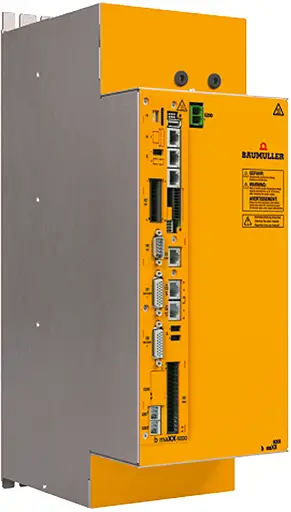
Systems with drive-integrated control technology are particularly suitable for:
- Applications with highly synchronous motion control
- Applications with stringent speed and quality requirements
- Modular machine concepts
- Applications with limited installation space
We implement drive-integrated intelligence with our b maXX converters, which cover a power range of up to 400 kW.
With the b maXX softdrivePLC and the b maXX drivePLC, we offer two different platforms for shifting intelligence to the converter.
b maXX softdrivePLC
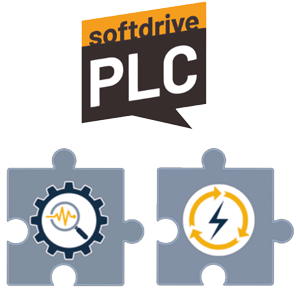
- For single-axis applications
- Motion control
- Analytics
- Modules
b maXX drivePLC
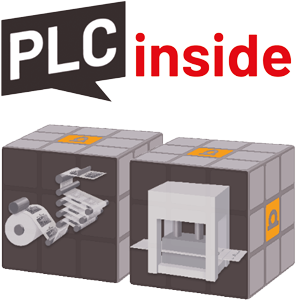
- For multi-axis applications
- Motion control
- IoT functions
- Templates
Conventional drive concepts with a central control architecture are suitable for the following applications:
- Standalone machines not connected to a production line
- Applications involving only simple movements
We implement central control architectures using the new Baumüller b maXX controllerPLC. The b maXX controllerPLC combines the real-time capabilities of an embedded PLC, the flexibility of an industrial PC, and modern IoT connectivity in a single platform.
Platforms
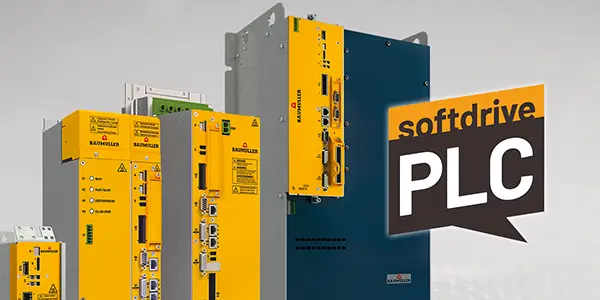
The b maXX softdrivePLC runs as part of the firmware in the Baumüller b maXX 6000, b maXX 5000, and b maXX 3300 drive concepts and is suitable for single-axis applications.
With the b maXX softdrivePLC, programs can run in the controller at cycle times as short as 62.5 μs, highly synchronized with the controller cycle. Using the b maXX softdrivePLC and the ProDrive parameterization tool, machine builders can conveniently implement simple control tasks locally in the controller. Numerous preconfigured software modules are available for motion control and analysis directly in the drive, including modules for servo pumps, cross cutters, and monitoring.
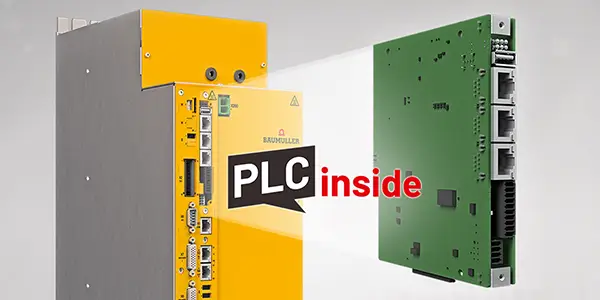
The drive-integrated control unit b maXX drivePLC can perform complex motion control, technology, and control functions directly in the drive. With the b maXX drivePLC, Baumüller’s preprogrammed motion control functions can be implemented without extensive modifications to the superordinated control. Distributing intelligence makes machines modular, simplifying commissioning and maintenance.
Its integration into the drive enables the drivePLC to achieve cycle times as short as 250 μs. The PLC is fully integrated into the Engineering Framework ProMaster. The b maXX drivePLC can be used as either a Sub Device or a Main Device. This enables hybrid control concepts with clusters comprising multiple submodules.
Real-time communication
The drivePLC communicates with the servo converter via an internal interface rather than the fieldbus. This provides access to drive parameters such as voltage, current, power, torque, speed, and position in “hard real time.” The servo drive thus performs sensor functions and enables smart monitoring with minimal effort.
With interfaces such as OPC UA, MQTT, EtherCAT, and Ethernet, the b maXX drivePLC is ideally equipped to meet requirements in automation and IoT environments. This high degree of openness improves development efficiency, time to market, and flexibility. The drivePLC’s digital and analog inputs are optimized for speed. Through its digital inputs, the b maXX drivePLC responds in real time to important events such as touch-probe signals.
The advantage: the control unit operates more efficiently and safely – a particular benefit for applications with stringent dynamic performance and precision requirements where fast response times are essential.
Write us a message, our sales experts will be happy to advise you.

 FAQ
FAQ
Frequently asked questions about Drive Intelligence from Baumüller
-
What advantages do intelligent servo drives offer over conventional drive solutions?
Intelligent servo drives increase communication speed within the system. Communication no longer takes place entirely via the fieldbus; part of it runs in parallel at the faster cycle rate of the drive control loop. This faster rate is the basis for shorter cycle times. Intelligent servo drives also enable distributed intelligence and, as a result, modular machine architectures. This reduces the processing load on the master control unit. If safety functions are integrated directly into the drive, fieldbus dead times are eliminated – for example, when STO is triggered. This can boost machine speed and shorten process cycle time without increasing risk at the machine. Integrated monitoring functions also help reduce machine downtime. Overall, this increases productivity and improves OEE.
-
What is the connection between intelligent servo drives and decentralized control architectures?
Shifting intelligence to the converter makes decentralized control architectures possible, allowing them to operate without a superordinated master control unit.
-
When does using an intelligent servo converter make economic sense?
Intelligent servo drives offer potential productivity gains when conventional architectures cannot support any further increase in machine speed. Output increases and OEE improves. Two effects in particular deliver economic benefits. First, separate control hardware can be eliminated because motion control and PLC functions run in the controller; depending on the concept, even the superordinated PLC can be eliminated. Second, machine modules can be manufactured independently of one another and commissioned in advance. Precommissioned machine modules significantly reduce the time required to commission the complete system at the user’s site.
-
Do the control functions in the converter require a license, or are they included in the hardware?
Whether the control functions in the converter require a license or are included in the hardware depends on the platform. The license-free Basic version of the b maXX softdrivePLC runs as part of the firmware and is included by default. The optional Extended version requires a license and can be configured using Baumüller’s preconfigured software modules or programmed by the machine manufacturer. Both versions can be used directly through the ProDrive parameterization tool. Depending on the version, the available functions range from logical operations, scaling, and simple closed-loop control tasks to analysis and motion control applications. The b maXX drivePLC, with its enhanced computing capacity and communication capabilities, is implemented as an additional hardware component in the servo drive.
-
How is the drive-integrated control unit programmed?
The drive-integrated control units b maXX softdrivePLC and b maXX drivePLC can be programmed in accordance with IEC 61131-3. The softdrivePLC integrated into the firmware is programmed using the ProDrive parameterization tool. Applications with greater complexity and connectivity that require the hardware-based drivePLC are implemented using the Engineering Framework ProMaster and its ProPROG programming environment. ProMaster includes tools such as the ProCAM cam disk editor. These and other functions are based on an internally developed IEC 61131-3 runtime environment for Linux with a real-time extension. Many applications can be implemented without custom programming: Baumüller provides preconfigured software modules, including ready-to-use machine modules such as the servo pump and cross cutter.
-
How are multiple axes synchronized when no superordinated control operates at the same cycle rate?
The b maXX drivePLC synchronizes multiple axes without a superordinated control by acting as an EtherCAT master and controlling additional servo converters. This reduces the processing load on the central PLC, allowing it to be downsized or, where appropriate, eliminated entirely. The b maXX drivePLC can be used as either a Sub Device or a Main Device. This enables hybrid control concepts with clusters comprising multiple submodules. With the b maXX softdrivePLC, fieldbus communication between two axes is no longer required. Master-slave functions can be implemented easily with the b maXX softdrivePLC. For dual-axis systems, parameters can be accessed across both axes.
-
Which fieldbuses do intelligent servo converters support?
The b maXX servo converters support all major fieldbus systems, including EtherCAT, PROFINET, POWERLINK, VARAN, CANopen, EtherNet/IP, and Modbus TCP. The b maXX drivePLC also supports the OPC UA and MQTT communication protocols and provides RS484 and CAN interfaces as well as a 1-gigabit Ethernet interface.
-
How do I access diagnostic and process data from the drive?
The drivePLC communicates with the servo converter via an internal interface rather than the fieldbus. This provides hard real-time access to drive parameters such as voltage, current, power, torque, speed, and position. The drivePLC makes the diagnostic and process data available to internal and external systems via an OPC server interface. In addition, the drivePLC features high-speed analog inputs with a minimum sampling time of 1 μs. External sensors can be connected directly to these inputs without additional hardware. The data is processed directly in the drive using function blocks from the SmartValue Toolkit.
-
How is drive data used for AI applications?
Drive data from intelligent servo converters can be preprocessed in the drive and shared directly with AI systems in the cloud via existing interfaces such as Ethernet and integrated standard protocols such as OPC UA and MQTT. This data transmission is faster than conventional fieldbus communication. High-speed data transmission enables complex AI applications for process self-optimization. The measured values already available in the drive provide the basis for this. No additional sensors are required. The Smart Condition Monitoring module performs vibration analysis directly in the drive and detects motor wear before it causes machine downtime. The Smart Energy Monitoring module measures the energy consumption of individual axes or the entire machine. The servo drive acts as a data hub. When additional sensors are connected, the servo drive also acts as a sensor hub.
-
Can safety functions such as STO and SS1 be implemented directly in the drive?
Yes, safety functions such as STO and SS1 can be implemented directly in the drive, with scalable options ranging from simple shutdown to advanced functions. In the b maXX 5000, three plug-in modules perform the safety functions. Depending on the module, the safety functions range from STO (safe torque off) to SP (safe position). The modules can be controlled via safe inputs or EtherCAT FSoE. The b maXX 6000 family also offers scalable safety variants. These are built in rather than implemented as modules. The b maXX 6000 family responds to safety-related events within 1 ms and can transmit the safe position to the safety control unit. Digital encoders can be used as safety encoders in the b maXX 6000 family. Here too, the drives are controlled via safe I/Os; certain variants can also be controlled via EtherCAT FSoE. The safety solutions comply with EN ISO 13849-1 up to Performance Level e and EN IEC 62061 up to SIL 3. Parameterization is performed using ProSafePara in accordance with IEC 61508. ProSafePara is available as a standalone tool and is also integrated into ProMaster.
-
Can I retrofit existing machines with intelligent drives?
Yes, intelligent servo converters can be integrated as submodules into existing architectures without major changes to the topology. Transitioning between generations within the b maXX family is also straightforward. The firmware of the b maXX 6000 series is fully compatible with its predecessor, the b maXX 5000 family. Parameter data sets can be transferred. Drive-based functions and softdrivePLC projects can continue to be used without modification. Only the FSoE parameterization requires minor adjustments.
-
What cybersecurity measures are required?
Baumüller’s intelligent servo converters are CRA-compliant. No additional measures are therefore required in a CRA-compliant IT ecosystem.