Optimal Drive Technology for Knee Levers Through ProSimulation
Baumüller integrates a model in ProSimulation to ensure the efficient and optimal design of electric drives for complex knee lever movements
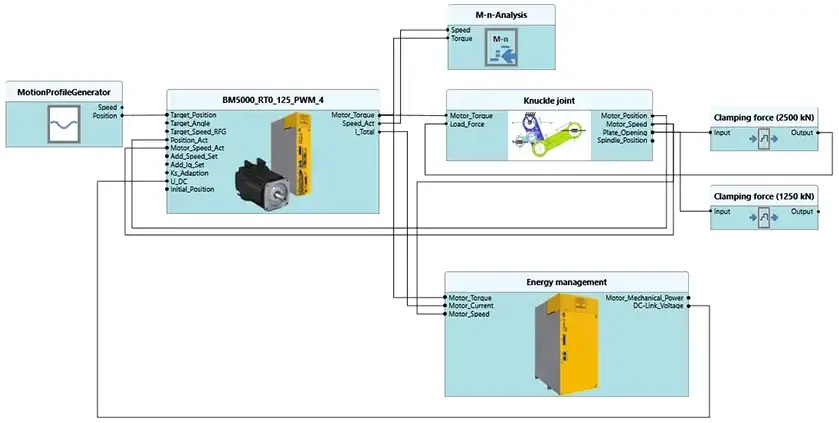 Simulation of an electrical locking unit with knee lever, facilitating the efficient design of the drive and motor and offering transparency regarding speed, torque, energy consumption, and other parameters.
Knee levers are used in mechanical engineering applications where high levels of force need to be transmitted via a low level of physical effort. This mechanical principle is used frequently, for instance, in presses, punching machines, bending machines, or locking systems in injection molding machines.
For mechanical engineers, designing the electric drives is a major challenge when implementing knee lever systems. Torques, speeds, rotational speeds, etc. are not linear in these comparatively complex systems. This makes designing them complicated, meaning that the drive system may not be dimensioned optimally for the machine cycle the user needs. Because of this, systems are often designed with a power buffer or are designed to be undersized.
 Baumüller creates models of knee levers and links them to the drive and motor model in its ProSimulation software module. This approach makes it possible to optimally design drive technology and test performance limits, without assembling a real test machine in advance.
Optimal performance design through simulation
Since the standard tools for designing knee levers are insufficient to obtain precise dimensions, Baumüller uses performant simulation tools to handle this task. First, the customer request is used to create a model of the knee lever. Then it is linked to the drive and motor model in the ProSimulation software module. This allows drive experts to accurately map the dynamic behavior of the machine and test out different force and movement profiles. This approach makes it possible for them to optimally design the drive technology and test performance limits, without assembling a real test machine in advance.
The advantage: Efficient components can be selected and dimensioned optimally in the design phase. The machine manufacturer can then simulate and assess individual cycles for their customer in the finished simulation. This makes it possible to avoid expensive performance reserves, for instance, as well as reduce malfunctions in system operation and improve efficiency and energy consumption.
